Schlage XceedID Compatible Proximity Cards: Buyer's Guide
Schlage XceedID readers accept standard 26-bit Wiegand proximity cards, which means compatible aftermarket credentials work identically to OEM Allegion product — same frequency, same bit format, same read range. American Key Cards supplies XceedID-compatible 125 kHz clamshell cards and key fobs programmed to your facility code, with no dealer account required. If your system uses aptiQ MIFARE DESFire EV1 smart cards with AES-128 site-key encryption, those cannot be cloned or sourced from any third party, and we say so clearly — but the large installed base of XceedID 125 kHz prox readers is fully covered.
What Is the Schlage aptiQ / XceedID Platform?
Allegion (parent company of Schlage) markets access credentials under two overlapping names. XceedID is the 125 kHz passive proximity line — the same technology category as HID Prox, AWID, and Indala. aptiQ is the broader platform name covering both the 125 kHz prox side and the 13.56 MHz smart card side. When a building uses aptiQ multi-technology readers, those readers can accept both credential types simultaneously, making them useful for phased migrations from legacy prox to higher-security smart cards.
The XceedID 125 kHz credentials are what most Schlage-equipped commercial and office buildings use day-to-day for standard door access. These are standard passive proximity cards and fobs operating at 125 kHz, using 26-bit Wiegand H10301 or 37-bit H10302 data output to the access control panel.
OEM Part Numbers and What They Mean
Allegion sells XceedID proximity credentials under several OEM part numbers. The most common are:
9557— XceedID ISO PVC card (printable, 26-bit)9558— XceedID clamshell card (26-bit)9559— XceedID key fob (26-bit)8980— aptiQ multi-technology card (125 kHz + 13.56 MHz MIFARE Classic)8491— aptiQ MIFARE DESFire EV1 card9492— aptiQ multi-technology fobMT20W— aptiQ multi-technology wall reader (reader unit, not a credential)
If your cards carry part numbers 9557, 9558, or 9559, you are running a pure XceedID 125 kHz installation. Compatible aftermarket cards work directly. If your site uses 8980 dual-technology credentials, the 125 kHz side of those cards is reproducible — the 13.56 MHz MIFARE Classic side has known vulnerabilities and is partially cloneable, but AKC does not perform MIFARE application cloning. If your site uses 8491 DESFire EV1 credentials with a site-specific AES-128 key, those are not reproducible by any third party.
How to Identify Your XceedID Reader
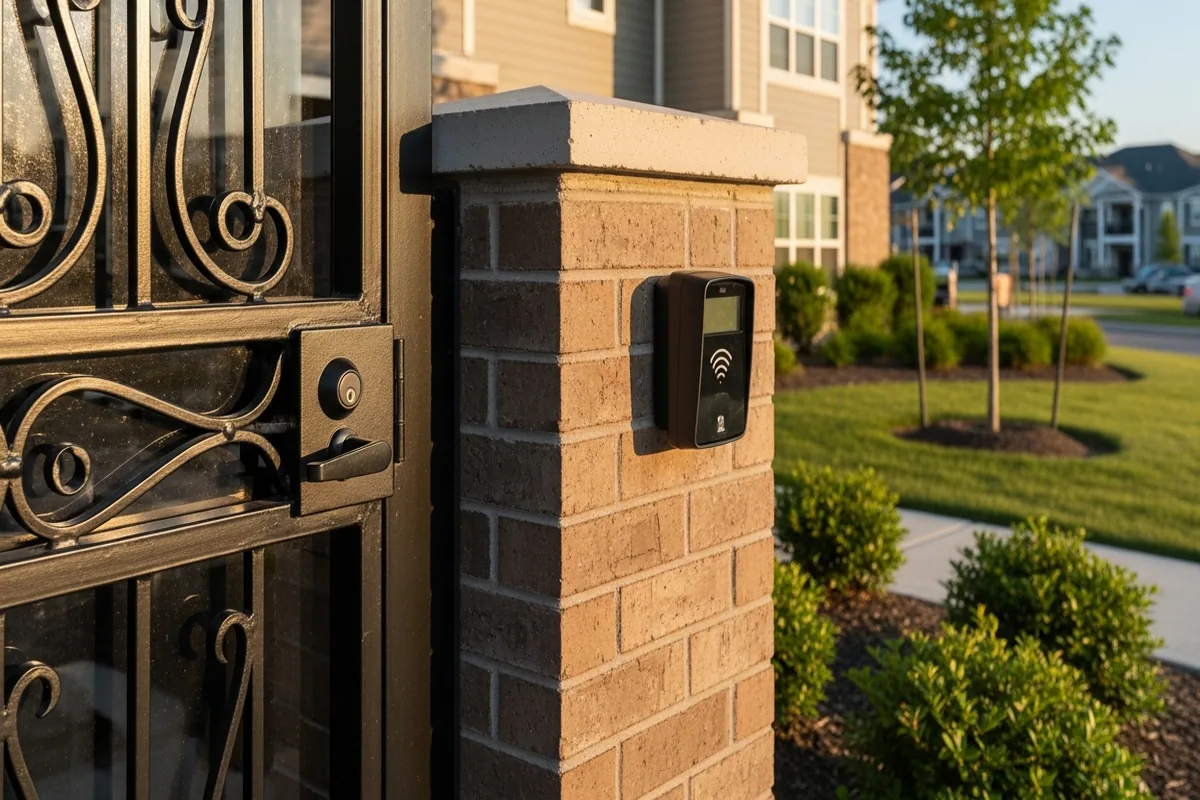
Look for the reader model number on the housing label. Schlage aptiQ multi-technology readers include the MT10, MT11, MT15, and MT20W series. These readers are typically silver or dark grey with the Schlage or aptiQ logo and accept a card wave from about 2-4 inches. XceedID standalone proximity readers have a single-technology housing without the dual-technology bezel characteristic of the MT series.
If you are unsure whether your site is running prox mode or smart card mode, check with your access control software or the original installer. If existing cards are thin ISO PVC or clamshell cards without a visible chip contact, they are almost certainly 125 kHz prox credentials.
Bit Formats: 26-Bit vs. 37-Bit
Most XceedID installations use 26-bit Wiegand H10301 — the most common access card format in North America. This encodes a facility code (1-255) and a card number (1-65,535) in a standard 26-bit data frame. A smaller number of sites use 37-bit H10302, which eliminates the facility code entirely and assigns each card a globally unique 35-bit card number (over 34 billion possible values). You will need to know which format your system was configured for before ordering.
For a full technical reference on the Schlage aptiQ / XceedID format, visit our Schlage aptiQ / XceedID format page. For a deeper look at how 26-bit Wiegand works, see our HID Prox H10301 format guide. If you are also evaluating AWID-format readers on the same property, see our AWID 26-bit format guide.
Can XceedID Prox Cards Be Cloned?
Yes, the 125 kHz XceedID prox credential is cloneable. It carries no encryption — the facility code and card number are transmitted in the clear over the Wiegand protocol. Commercially available RFID duplicators can read and copy these cards. This is the same security posture as every other standard 125 kHz proximity format (HID Prox, AWID, Farpointe Pyramid, and so on). The cloneability is a property of the 125 kHz passive proximity technology, not a specific Schlage characteristic.
The aptiQ DESFire EV1 smart cards are a different matter entirely. With a properly configured non-default AES-128 site key, those credentials are cryptographically secure and there are no known practical attacks against them. American Key Cards does not and cannot clone or reproduce DESFire EV1 cards with site-specific AES keys.
Compatible Readers
The following readers work with standard XceedID-compatible 125 kHz credentials:
- Schlage aptiQ
MT10multi-technology reader (125 kHz mode) - Schlage aptiQ
MT11multi-technology reader (125 kHz mode) - Schlage aptiQ
MT15multi-technology reader (125 kHz mode) - Schlage aptiQ
MT20Wmulti-technology wall reader (125 kHz mode) - XceedID standalone 125 kHz proximity readers
- Any Wiegand 26-bit or 37-bit compatible reader
Note that when an aptiQ multi-technology reader is configured to read DESFire EV1 smart cards, it may stop accepting 125 kHz credentials depending on the system configuration. Confirm with your integrator which credential mode your readers are active in.
OEM vs. Compatible: Spec Comparison
| Feature | Allegion OEM (9557/9558/9559) | AKC Compatible Card |
|---|---|---|
| Frequency | 125 kHz | 125 kHz |
| Bit format | 26-bit H10301 / 37-bit H10302 | 26-bit H10301 / 37-bit H10302 |
| Facility code programmable | Yes | Yes |
| Read range | Standard proximity (~3-5 cm) | Standard proximity (~3-5 cm) |
| Wiegand output | Standard | Standard |
| Available without dealer | No | Yes |
| Minimum order | OEM/distributor minimums apply | No minimum |
| Affiliation with Allegion | OEM product | Compatible by specification, not affiliated |
AKC credentials are compatible by specification with the XceedID 125 kHz reader ecosystem. We are not affiliated with Allegion or Schlage, and our cards are not genuine OEM product — they are aftermarket credentials that meet the same electrical and data specification.
Ordering: What You Need
To order XceedID-compatible cards or fobs from American Key Cards:
- Facility code — the site code programmed into your existing cards (1-255 for 26-bit systems). This is usually printed on the card or available from your installer’s records.
- Card number range — the sequential numbers you need. Most orders replace a batch of lost cards or add new employee numbers.
- Bit format — 26-bit H10301 (most common) or 37-bit H10302.
- Form factor — clamshell (standard thick card for easy handling), ISO PVC (standard card thickness, printable), or key fob.
You do not need to provide the reader model number, the access control software brand, or any other system information. The credential specification is defined entirely by the facility code, card number, and bit format.
Industries and Use Cases
XceedID 125 kHz proximity credentials are used across a wide range of commercial environments:
- Commercial office buildings using Schlage aptiQ readers during phased smart card migration
- Hospitality and hotels with legacy prox infrastructure on aptiQ hardware
- Light industrial and warehouse facilities needing rugged clamshell cards or fobs
- Multi-tenant commercial real estate where property managers need to reorder cards without going through a Schlage dealer
- FIPS 201-adjacent installations using aptiQ multi-technology readers that accept both prox and smart card credentials
Why Non-OEM Costs Less
Allegion distributes XceedID credentials through a network of authorized security integrators and dealers. Dealer channel pricing includes distributor margin, minimum order quantities, and the cost of managing a dealer relationship. American Key Cards sources compatible 125 kHz credentials directly and programs them to your specification, removing those channel costs. The credential you receive works identically in your XceedID reader — the savings come from the supply chain, not from any reduction in specification.
For a broader explanation of how compatible and OEM access credentials compare, see our how it works page.
Ready to Order?
If your building runs XceedID 125 kHz proximity readers — whether standalone prox units or aptiQ multi-technology readers in prox mode — American Key Cards can supply compatible clamshell cards and key fobs programmed to your facility code, shipped without dealer minimums or dealer markups. Contact us with your facility code, card number range, and preferred form factor and we will confirm availability and pricing the same business day.
Frequently asked questions
Can I use a standard 26-bit proximity card in a Schlage XceedID reader?
Yes. XceedID standalone 125 kHz proximity readers and the aptiQ multi-technology readers (MT10, MT11, MT15, MT20W) all accept standard 26-bit Wiegand H10301 credentials. As long as the card is encoded with your facility code and card number, it will work the same as an OEM Schlage card. The Wiegand output sent to the access panel is identical.
What is the difference between aptiQ and XceedID credentials?
XceedID refers to Allegion's 125 kHz passive proximity credential line, using standard 26-bit or 37-bit Wiegand format. aptiQ is the 13.56 MHz smart card platform using MIFARE Classic or MIFARE DESFire EV1 with AES-128 encryption. Both technologies can be read by aptiQ multi-technology readers, but only the XceedID 125 kHz side is available from aftermarket suppliers.
Are Schlage aptiQ DESFire cards cloneable or available from third parties?
No. aptiQ MIFARE DESFire EV1 credentials programmed with a non-default site key use AES-128 encryption that cannot be reproduced by any third-party supplier. Only the 125 kHz XceedID proximity side is replaceable from aftermarket sources. If your system relies exclusively on DESFire EV1 smart cards, you must obtain replacements through an authorized Allegion integrator.
What information do I need to order compatible XceedID cards?
You need your facility code and the card number or range you want programmed. The facility code is usually printed on your existing cards or available from the original installer's records. For 26-bit Wiegand (H10301), facility codes run 1-255 and card numbers run 1-65,535. For 37-bit (H10302), there is no facility code — only a unique card number.